Indoor cats can live happy, healthy and fulfilling lives when their physical, mental and social needs are met. Learning how to keep indoor cats happy involves more than providing food and a comfortable place to sleep. Cats need opportunities to play, explore, scratch, climb, hunt, observe and interact with their environment.
With the right indoor cat enrichment, stimulating cat toys, interactive activities and a predictable daily routine, you can reduce cat boredom and encourage healthy physical and mental activity.
Quick Summary
- Provide different types of cat toys and rotate them regularly.
- Use interactive cat games to encourage natural hunting and chasing behaviours.
- Create safe vertical spaces where your cat can climb, observe and relax.
- Use food puzzles and other activities for mental stimulation for cats.
- Give your cat daily opportunities for exercise, exploration and social interaction.
- Watch for signs of boredom and change the environment when necessary.
Why Is Indoor Cat Enrichment Important?
Indoor cat enrichment means providing activities, spaces and experiences that allow cats to express natural behaviours such as hunting, climbing, scratching, exploring and playing. A stimulating indoor environment can help keep cats physically active and mentally engaged while making their everyday surroundings more interesting.
Indoor enrichment is particularly important because indoor cats have fewer opportunities to explore changing outdoor environments. Enrichment helps turn an ordinary home into an environment where your cat can exercise its body and mind.
Benefits of Indoor Cat Enrichment
| Enrichment Activity | Main Benefit |
| Interactive play | Physical exercise and bonding |
| Puzzle feeders | Mental stimulation |
| Scratching posts | Natural scratching behaviour |
| Cat trees | Climbing and observation |
| Toy rotation | Reduces boredom |
| Hiding places | Security and relaxation |
| Window observation | Environmental stimulation |
| Training games | Mental engagement |
1. Give Your Cat Interactive Playtime Every Day
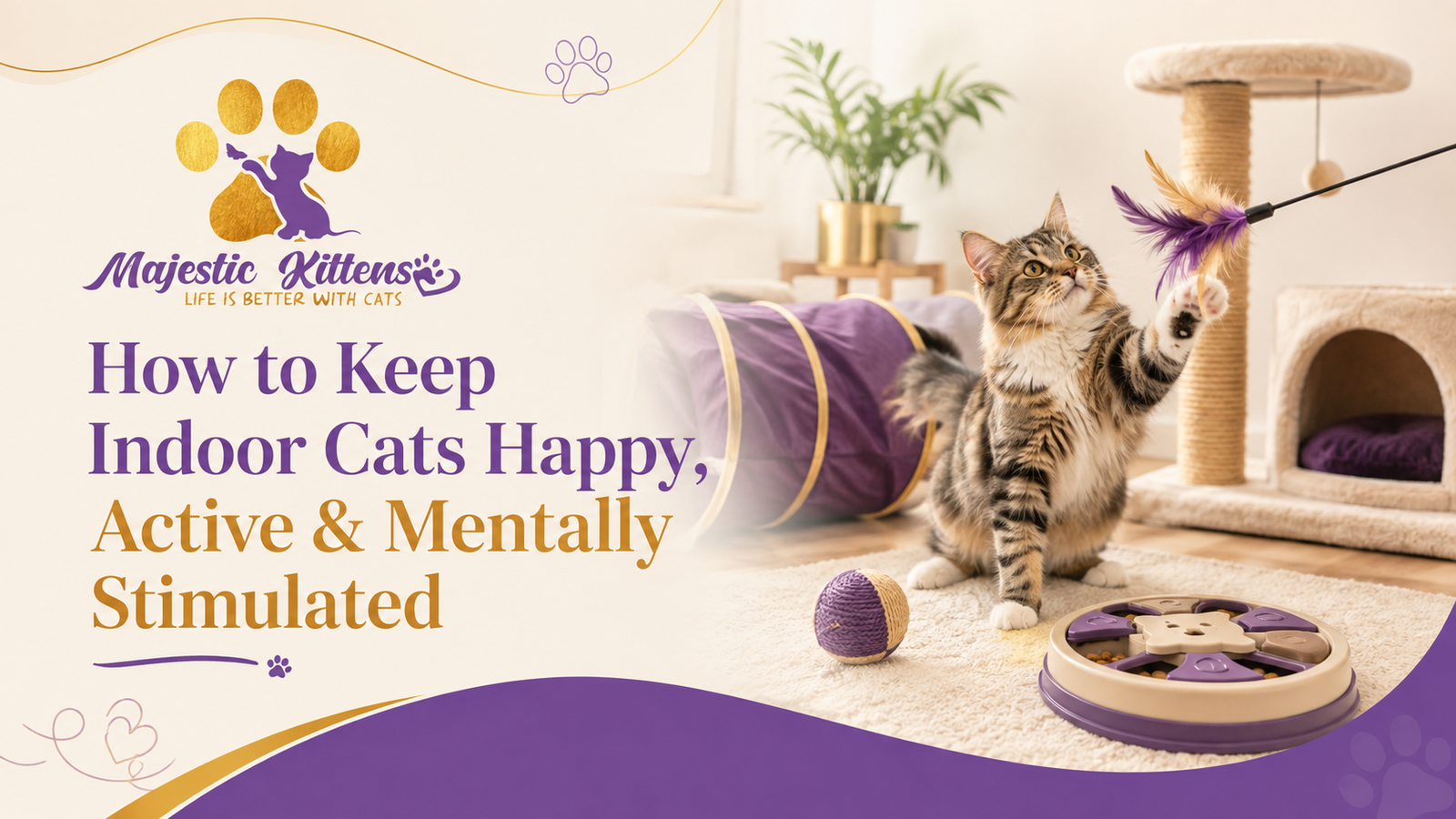
Interactive play is one of the simplest ways to keep an indoor cat active. Instead of leaving toys around all day, spend dedicated time playing with your cat using toys that encourage chasing, pouncing and stalking.
Try activities such as:
- Wand toys
- Feather toys
- Moving toys
- Toy mice
- Balls
- Tunnels
- Chase toys
The goal isn’t simply to make your cat run around. Good interactive cat games imitate parts of the natural hunting sequence and encourage your cat to think, chase and react.
How Long Should You Play With an Indoor Cat?
There is no single playtime schedule that works for every cat. Age, breed, personality and energy level all influence how much activity a cat wants.
A practical approach is to provide several short play sessions throughout the day rather than relying on one long session.
For example:
Morning → Interactive play → Breakfast
Afternoon → Independent toy activity
Evening → Interactive play → Meal → Relaxation
Observe your cat and adjust the routine according to its energy level.
2. Use Cat Toys to Prevent Boredom
Cat toys provide opportunities for cats to chase, bat, pounce, stalk and explore. However, keeping dozens of toys permanently available does not necessarily make play more interesting.
Instead, rotate your cat’s toys.
Try a Cat Toy Rotation
Keep some toys stored away and introduce different ones every few days.
For example:
- Day 1–2: Wand toy + ball
- Day 3–4: Toy mouse + tunnel
- Day 5–6: Puzzle toy + kicker toy
- Day 7: Introduce previously stored toys
Toy rotation can make familiar toys feel new again and can be a simple way to address cat boredom.
Safety Tip
Always supervise your cat with toys containing strings, feathers, small detachable parts or other components that could potentially be swallowed. Put away interactive toys when playtime is finished.
3. Try Interactive Cat Games
Interactive cat games combine physical movement with mental challenges. They can be especially useful for indoor cats that do not have access to outdoor exploration.
Some simple games include:
Hide and Seek
Hide a toy behind furniture or around a safe area and encourage your cat to find it.
Chase the Toy
Move a wand or toy across the floor and allow your cat to stalk and chase it.
Treat Hunt
Hide small amounts of your cat’s regular food around safe areas of the home and encourage your cat to search.
The Box Game
Place toys or treats inside cardboard boxes with openings that allow your cat to investigate safely.
Follow the Toy
Move a toy through a tunnel or around furniture so your cat has to follow its movement.
These activities provide both physical exercise and mental stimulation for cats.
4. Create a Cat-Friendly Vertical Space
Cats naturally enjoy climbing and observing their surroundings from elevated locations. A cat tree, shelf or secure elevated resting area can provide valuable enrichment.
A good indoor cat environment can include:
- Cat trees
- Scratching posts
- Secure shelves
- Window perches
- Climbing areas
- Covered resting spaces
Vertical spaces also give cats the ability to choose where they want to relax.
Make sure shelves, cat trees and other elevated areas are stable and safely installed.
5. Give Your Cat a Window View
A secure window can provide hours of visual stimulation.
Your cat may enjoy watching:
- Birds
- People
- Trees
- Other animals
- Moving objects
- Changing weather
A comfortable window perch can therefore become part of your indoor cat enrichment routine.
However, windows should always be properly secured. Do not allow cats access to unsafe open windows or balconies.
6. Use Puzzle Feeders for Mental Stimulation
Food-based enrichment can turn mealtime into a mental activity.
Puzzle feeders and food-dispensing toys can encourage cats to work for small amounts of food rather than simply eating from a bowl.
This can provide:
- Problem-solving opportunities
- Mental engagement
- Slower eating
- Natural foraging behaviour
- Additional activity during the day
If you introduce a puzzle feeder, start with an easy design and gradually increase the difficulty as your cat becomes comfortable using it.
7. Provide Scratching Opportunities
Scratching is a normal feline behaviour. Instead of trying to stop your cat from scratching, provide appropriate scratching surfaces.
Consider offering:
- Vertical scratching posts
- Horizontal scratchers
- Cardboard scratchers
- Sisal scratching posts
Place scratching areas near places where your cat already spends time.
For example, if your cat scratches after waking up, placing a scratching post near its sleeping area may make it more appealing.
8. Create Safe Hiding and Resting Areas
Mental stimulation does not mean your cat needs to be active all day.
Cats also need opportunities to rest and retreat.
Provide safe spaces such as:
- Cat beds
- Cardboard boxes
- Covered cat houses
- Quiet corners
- Elevated resting areas
Having choices allows your cat to decide when it wants to play and when it wants to relax.
A balanced environment should therefore include both active enrichment and quiet spaces.
9. Rotate Your Cat’s Environment
You don’t necessarily need to buy something new every time your cat seems bored.
Small environmental changes can create new opportunities for exploration.
You can:
- Move a scratching post to another safe location.
- Introduce a cardboard box.
- Change the location of a toy.
- Create a new play area.
- Introduce a new puzzle feeder.
- Change which window perch is available.
- Rotate toys.
These simple changes can help make an indoor environment more interesting.
10. Spend Quality Time With Your Cat
Human interaction is another important part of keeping many indoor cats happy.
Depending on your cat’s personality, quality time could include:
- Playing together
- Gentle grooming
- Training
- Talking to your cat
- Petting
- Sitting together
- Offering interactive toys
Remember that every cat has a different personality. Some cats may actively seek interaction, while others prefer shorter periods of attention.
Respect your cat’s body language and allow it to move away when it wants space.
11. Train Your Cat With Simple Games
Cats can learn simple behaviours through positive reinforcement.
You can introduce basic training such as:
- Coming when called
- Touching a target
- Sitting
- Entering a carrier
- Following a toy
- Using a scratching post
Keep training sessions short and reward desirable behaviours appropriately.
Training can provide another form of mental stimulation for cats, particularly for curious and food-motivated cats.
How to Tell If Your Indoor Cat Is Bored
Cat boredom can sometimes appear as changes in behaviour. A cat that lacks sufficient stimulation may show behaviours such as excessive attention-seeking, destructive scratching, reduced interest in activities or repetitive behaviours.
However, behavioural changes can also have medical or environmental causes. A sudden or persistent change in behaviour should be discussed with a veterinarian.
Possible Signs That Your Cat Needs More Enrichment
- Reduced interest in normal activities
- Excessive attention-seeking
- Destructive behaviour
- Excessive scratching
- Repetitive behaviours
- Restlessness
- Lack of interest in toys
- Changes in eating habits
Rather than assuming boredom is the cause, consider your cat’s overall behaviour, environment and health.
Indoor Cat Enrichment Ideas for Busy Cat Parents
If you have a busy schedule, you can still provide meaningful enrichment.
| Time | Activity |
| Morning | 10–15 minute interactive play |
| Before leaving | Puzzle feeder or food activity |
| Afternoon | Window observation or independent toy |
| Evening | Interactive cat game |
| Night | Quiet bonding and grooming |
The exact schedule can be adapted according to your cat’s age, health, personality and routine.
Which Cat Breeds Can Enjoy Indoor Living?
Many cats can adapt well to indoor living when their environment provides appropriate exercise, enrichment and social interaction.
Majestic Kittens currently features breeds including Persian, British Shorthair, Bengal, Ragdoll, Maine Coon, Siamese, Himalayan and Bombay cats, among others.
However, individual personality and energy level matter just as much as breed. For example, a highly energetic cat may require more interactive play and climbing opportunities than a naturally relaxed cat.
If you are considering bringing home a kitten, you can explore the Cat Breeds available through Majestic Kittens.
How Majestic Kittens Supports Happy, Well-Socialized Kittens
Majestic Kittens emphasizes a cage-free, home-like environment where kittens receive human interaction and opportunities to explore. The website also states that its kittens receive veterinary care, vaccination and grooming, along with support for new cat owners.
For new cat parents, this support can be useful because bringing home a kitten involves more than choosing a breed. You also need to prepare the home, understand feeding and grooming requirements, establish routines and provide appropriate enrichment.
Majestic Kittens also provides a cat food, toy and accessories kit, which can be relevant when preparing for a new kitten.
Indoor Cat Happiness Checklist
Before bringing a kitten or cat home, make sure you have considered these essentials:
- Interactive cat toys
- Scratching post
- Comfortable sleeping area
- Safe hiding space
- Vertical climbing area
- Window perch
- Food and water bowls
- Appropriate food
- Litter box
- Puzzle or enrichment activity
- Safe play area
- Regular veterinary care
The goal is not to create a complicated environment. It is to provide your cat with choice, activity, exploration, interaction and rest.
Frequently Asked Questions
How do I keep my indoor cat happy?
Keep your indoor cat happy by providing regular interactive play, appropriate cat toys, scratching areas, climbing opportunities, safe hiding spaces and mental enrichment. A predictable routine combined with environmental variety can help keep your cat active and engaged.
How can I mentally stimulate my indoor cat?
Use puzzle feeders, food-search games, interactive cat games, training exercises and toy-based activities. Rotating toys and changing enrichment activities can also provide new experiences.
How do I stop my indoor cat from getting bored?
Reduce cat boredom by providing daily play, opportunities to climb and scratch, window observation, food puzzles and toy rotation. Short interactive sessions throughout the day can be more practical than relying on toys left on the floor.
What are the best toys for indoor cats?
Useful cat toys include wand toys, balls, toy mice, tunnels, puzzle feeders and other toys that encourage chasing, stalking, batting or problem-solving. Choose toys appropriate for your cat and supervise toys with small or detachable parts.
Do indoor cats need exercise?
Yes. Indoor cats benefit from regular physical activity. Interactive play, climbing, chasing games and movement-based enrichment can help them stay active.
Can indoor cats be happy without going outside?
Yes. Indoor cats can have fulfilling lives when their environment provides adequate physical exercise, mental stimulation, social interaction, safe exploration and comfortable resting areas.
How often should I play with my indoor cat?
Aim for multiple short play sessions rather than focusing on one fixed duration. The ideal routine depends on your cat’s age, health, energy level and personality.
Does breed affect how much enrichment a cat needs?
Breed can influence general temperament and activity tendencies, but individual personality is important too. Observe your cat’s behaviour and adjust its play, exercise and enrichment accordingly.